
On Homunculi & Electric Sheep
how a neurosurgeon’s study of epilepsy led to blade runner
Upon returning to London for the spring semester, RVC spared no time in diving right in. We kicked off the term with the neurology unit. Over the last two weeks, we had discussed everything brain, nerves, and spinal cord. I even had a brain dissection last week. It was a sheep brain and it was significantly smaller than I had expected. It sat neatly in my palm and was hardly bigger than an apple. I do have pictures, if you’re really curious. I had to turn them in for an assignment and now I just have brain pictures sitting casually in my photo library.
It’s not uncommon for a niche fact to get dropped in the middle of lecture before it gets completely washed away in the onslaught of content. I’ve been trying to collect more of them to share. It’s so funny because they get mentioned, you stop and think about it for a millisecond, and by then, the lecturer has just sped right along. This fact came up just like that. We were in the depths of discussion about the somatosensory cortex and my lecturer just so casually goes, “This was the inspiration for Blade Runner. Anyway, there are three sensory pathway modalities…”
She specifically was referencing the Penfield Homunculus. The Penfield Homunculus was created by neurosurgeon, Wilder Penfield, as a product of his time working on epileptic patients in the 1930s. He was performing a procedure now titled the Montreal procedure (Penfield was working in Canada) where the patient is conscious (and importantly, locally anaesthetized) during surgery. In pursuit of pinpointing the region responsible for their epilepsy, Penfield would prod sections of the brain and send electrical signals through the tissues and have the patient report back on what they felt. With each patient, Penfield gained more and more information on the brain and eventually was able to develop a ‘map’ of the brain which would become the homunculus. This map depicts different regions of the brain being specifically responsible for certain regions of the body. It is notably an inverted image, with the region for the toes at the top of the brain and region responsible for the face lower in the brain.
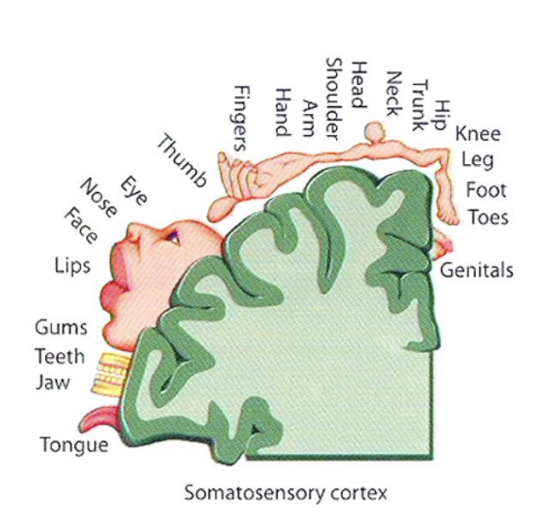
Wilder Penfield’s homunculus of the somatosensory cortex. Source: RVC lecture slides
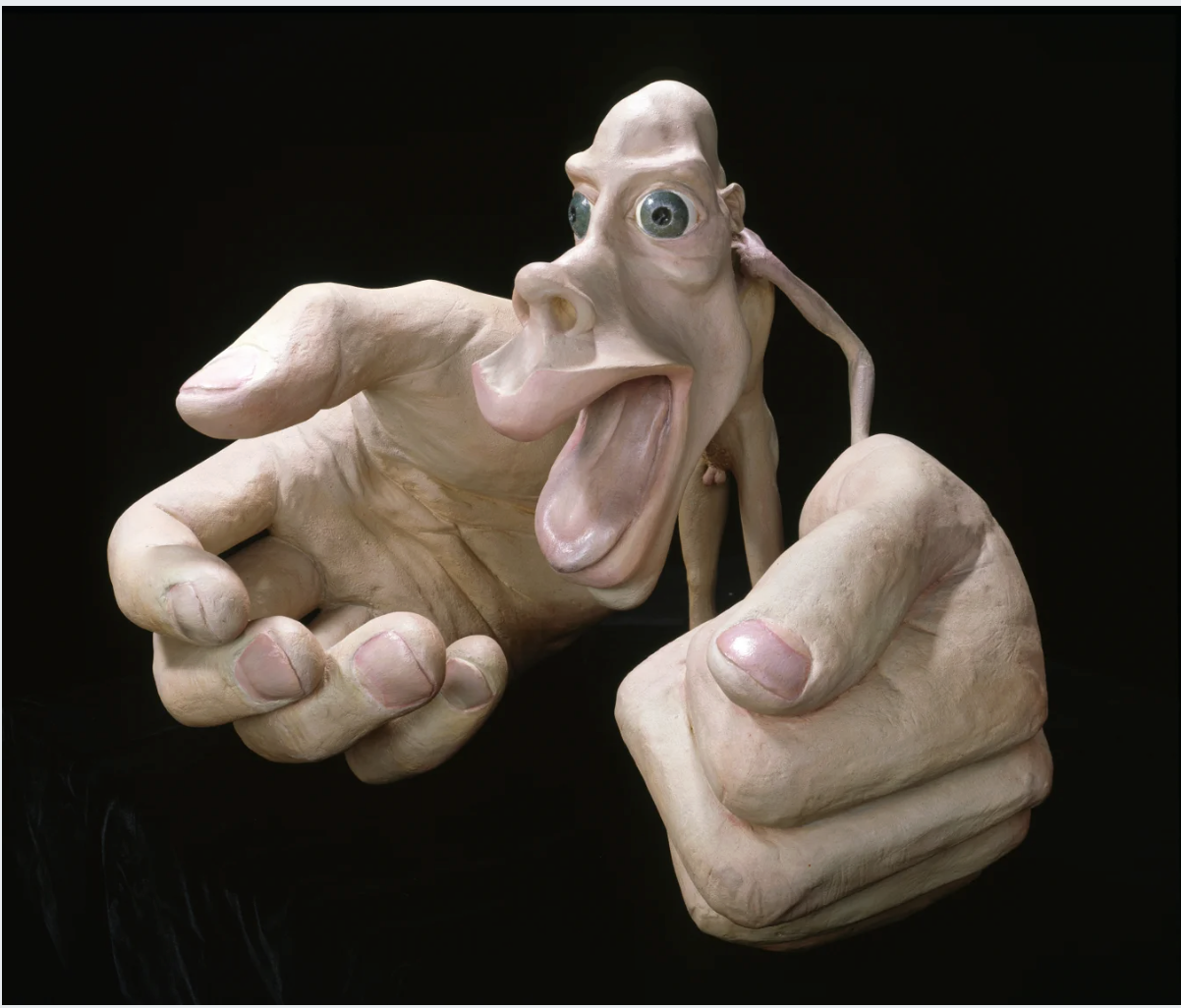
Model of the homunculus, demonstrating the disproportionate regions of the body. Source: Scientific American
As seen above, the map of body parts forms a strange ‘little man’. What is perhaps most stark in the illustration is the disproportionate sizing of different features. For example, the lips are significantly larger than the knee. This is a key concept called disproportionate somatotopic representation. Somatotopy is this idea that each part of the body has a corresponding portion in the central nervous system in a one-to-one manner. The idea of it being disproportionate captures the fact there are regions of the body that are more heavily innervated and managed in the brain. In humans, the lips, face, and fingers contain significant innervation. These are critical tools for navigating the world and sensing it. The cortex is responsible for both sensation and motor (movement). Therefore, these get a disproportionate amount of surface area in the brain given the higher concentration of nerve endings that supply these key features. Interestingly, it is thought that these proportions are different in different species, pending their evolutionary and anatomical needs. For example, moles have a region of the cortex dedicated to their whiskers, nose, and front paws as these are critical for burrowing and navigating their world.

Homunculi models of moles, demonstrating how evolution is reflected in their somatotopic maps.
Source: The Tangled Bank, 2nd ed., Carl Zimmer, Roberts & Company 2013 & featured in National Geographic
Penfield’s work was groundbreaking at the time and held water for decades. And, it mostly still does. However, given that it was published in the late 1930s, there has been some updating to the idea. Though there were several research articles published over the course of the 2000s that pressured Penfield’s homunculus, the final article that confirmed the inaccuracies of the ‘little man’ came out in 2023. Published in Nature, the study posits that the motor cortex is not continuously somatotopic, as Penfield suggested. Instead, using fMRI scans, they proposed that there are 3 regions that interrupt the homunculus and play a role in coordinating complex motion and action planning. These regions are dubbed the somato-cognitive action network (SCAN). The cortex is then separated into an “integrate and isolate” pattern with areas specifically for integrating movement between regions (by SCAN) and areas isolated for specific and fine movement.
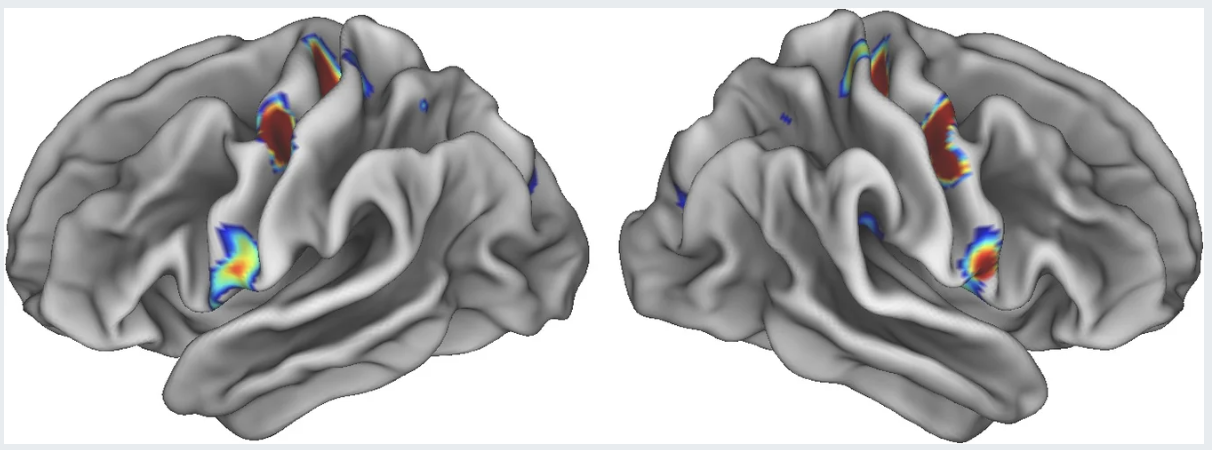
The three colored spots on each half of the brain represent areas responsible for action planning and regulation in the somatosensory cortex. They represent the ‘integrate’ portion of the cortex that is interspersed in the isolated, body-part specific regions.
Credit: Evan Gordon/Washington University & featured in Nature and Scientific American.
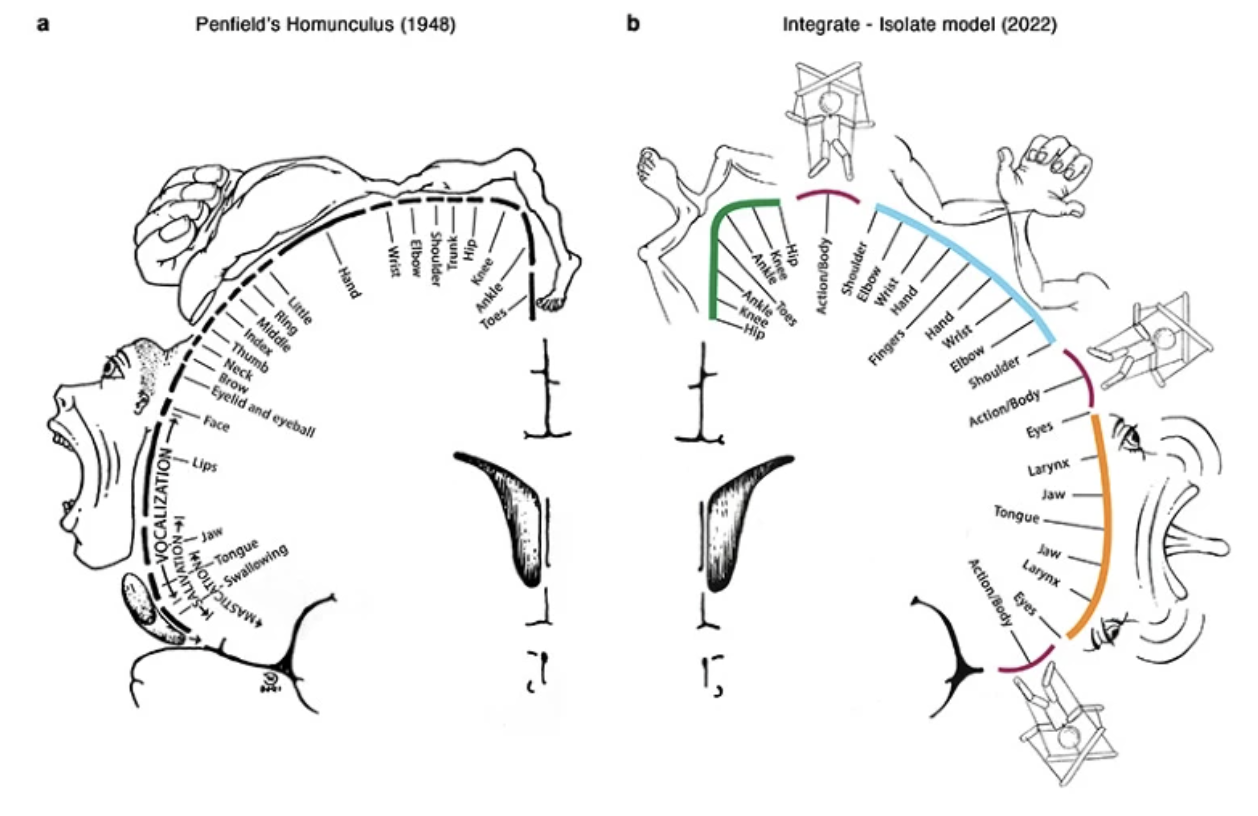
(A) The original Penfield motor homunculus depicts the continuous map of dedicated regions of the cortex to the body & (B) The revised diagram featuring SCAN (somato-cognitive action network) that creates the “integrate-isolate” model of the cortex.
Source: Gordon, E.M., Chauvin, R.J., Van, A.N. et al. A somato-cognitive action network alternates with effector regions in motor cortex. Nature617, 351–359 (2023). https://doi.org/10.1038/s41586-023-05964-2
It doesn’t completely kill the Penfield homunculus but just adds an important and critical caveat and level of complexity. In an opinion article, one of the researchers even discusssed that the homunculus is an excellent tool for the education of medical students but it’s not perfect. It’s certainly compelling to think of a little guy in the brain but it’s just not the whole picture.
By now you’re wondering when I’ll stop all the science jargon and finally explain the Blade Runner link. Thank you for your patience! So, Blade Runner is an adaptation of a book called, “Do Androids Dream of Electric Sheep?” by Philip K. Dick. It’s a work of science-fiction that follows the bounty hunter, Rick Deckard, on his mission to “retire” rogue androids. It’s important to note that I have neither read “Do Androids Dream of Electric Sheep?” or seen Blade Runner. Criminal, I know. I have to watch it now, I think. But, my understanding is that much of the book and movie are about questioning what it means to be human and a meditation on the human experience in a technological world. The book specifically opens on Rick and his wife being woken up by a little device, a Penfield mood organ. Rick wakes cheerfully and his wife, Iran, wakes un-merrily. The device regulates and controls a user’s emotions using electrical currents. Change the settings, and wake up rested and cheerful. Dial 888, experience the desire to watch the TV. Dial 3, and be stimulated to want to dial another feeling.
It’s undoubtedly a reference to Wilder Penfield. The device sends electrical impulses and stimulates regions of the brain, not unlike the Montreal procedure. It, of course, differs in that Penfield’s work reflects mainly motor control, though there was some overlap with memories and emotions in his research. Regardless, this opening scene and device set the stage for the entire novel. Rick and Iran argue about Iran’s existentialism and pursuit of experiencing despair—an emotion warned against by the machine, Rick, and seemingly the world. It certainly kicks off the larger commentary on the human experience, especially when there is clear integration of machinery into the society. I’m definitely interested in reading more at some point. It’s seems especially poignant to read now given the rise of AI. Its commentary on the blurring between humanity and machines and the negative impact of technological integration on the human experience feels apt.
I read an article discussing the history of Blade Runner and “Do Androids Dream of Electric Sheep?” and it suggested that the smartphone is the now “ultimate mood organ” as people’s emotions are readily manipulated by algorithms. Despite the article being written in 2018, it goes on to comment that philosophers at the time were already proposing the idea of testing how much of humanity remains in a human when they are so readily influenced by a world of algorithms. Moreover, the original book had a test designed to identify machines that were indistinguishable from humans which feels like a critical concept as AI becomes more and more difficult to discern. Anyway. I’ll report back if I get around to reading it!
Tangent aside, Wilder Penfield literally sets the stage for the entire book, “Do Androids Dream of Electric Sheep?” and therefore, the creation of the movie, Blade Runner.
References
Bhattacharya, A. (2018). Where Blade Runner began: 50 years of Do Androids Dream of Electric Sheep? Nature, 555(7695), 163–164. https://doi.org/10.1038/d41586-018-02695-7
Costandi, M. (2024, March 1). Rethinking the homunculus. Aeon. https://aeon.co/essays/the-iconic-brain-map-thats-changing-neurosurgery-and-gaming
Dosenbach, N. U. F. (2023, April 21). How Our Team Overturned the 90-Year-Old Metaphor of a “Little Man” in the Brain Who Controls Movement. Scientific American. https://www.scientificamerican.com/article/how-our-team-overturned-the-90-year-old-metaphor-of-a-little-man-in-the-brain-who-controls-movement1/
Gordon, E. M., Chauvin, R. J., Van, A. N., Rajesh, A., Nielsen, A., Newbold, D. J., Lynch, C. J., Seider, N. A., Krimmel, S. R., Scheidter, K. M., Monk, J., Miller, R. L., Metoki, A., Montez, D. F., Zheng, A., Elbau, I., Madison, T., Nishino, T., Myers, M. J., … Dosenbach, N. U. F. (2023). A somato-cognitive action network alternates with effector regions in motor cortex. Nature, 617(7960), 351–359. https://doi.org/10.1038/s41586-023-05964-2
Kozlov, M. (2023). Famous ‘homunculus’ brain map redrawn to include complex movements. Nature. https://doi.org/10.1038/d41586-023-01312-6
Kumar, R., & Yeragani, V. K. (2011). Penfield – A great explorer of psyche-soma-neuroscience. Indian Journal of Psychiatry, 53(3), 276–278. https://doi.org/10.4103/0019-5545.86826
Ladino, L. D., Rizvi, S., & Téllez-Zenteno, J. F. (2018). The Montreal procedure: The legacy of the great Wilder Penfield. Epilepsy & Behavior, 83, 151–161. https://doi.org/10.1016/j.yebeh.2018.04.001
Zimmer, C. (2013, July 24). Mouseunculus: How The Brain Draws A Little You. National Geographic. https://www.nationalgeographic.com/science/article/mouseunculus-how-the-brain-draws-a-little-you
